Here is a quick look at the most popular AAK! posts of 2010.
Most Viewed Posts of 2010 (All-Time)
1. Everything You Ever Wanted to Know About Korean Men
2. AAK! Wiki: Oppa! Oppa! Oppa!
3. Why is StarCraft Popular in Korea?
4. The Ultimate Korean Looks List
5. The Korean's English Acquisition
Most Viewed Posts of 2010 (Written in 2010)
1. Why is StarCraft Popular in Korea?
2. The Korean's English Acquisition
3. North Korean Jokes
4. State of ESL Teachers in Korea
5. Healthcare System in Korea
As of December 30, the Korean answered 1,236 questions (not counting follow-up questions) over the email in 2010. Thank you for all your questions, and happy new year!
Got a question or a comment for the Korean? Email away at askakorean@gmail.com.
Thursday, December 30, 2010


Tuesday, December 21, 2010
Ask a Korean! News: Joint Statement by Korean & Japanese Bar Association on Comfort Women and Forced Laborers
The Korean is heartened by the fact that, at the centennial of Japan's annexation of Korea, conscientious Japanese people are speaking up in order to bring justice and closure to the war crimes that Japan committed. Such effort should be loudly proclaimed and well-publicized.
Recently, Korean Bar Association and Japan Federation of Bar Associations -- the representatives of attorneys of the respective nations -- issued a joint statement and a proposal regarding the comfort women and forced mobilization issue. In the spirit of getting these small steps toward reconciliation more publicized, below is the translation of the entire thing.
The Korean is struck by the strong tone of the statement -- a few steps ahead of the Joint Statement of Korean and Japanese Scholars, which was already a pretty strong statement. The Korean applauds everyone who made this happen.
The translation was done from Korean version. The source is here.
Recently, Korean Bar Association and Japan Federation of Bar Associations -- the representatives of attorneys of the respective nations -- issued a joint statement and a proposal regarding the comfort women and forced mobilization issue. In the spirit of getting these small steps toward reconciliation more publicized, below is the translation of the entire thing.
The Korean is struck by the strong tone of the statement -- a few steps ahead of the Joint Statement of Korean and Japanese Scholars, which was already a pretty strong statement. The Korean applauds everyone who made this happen.
The translation was done from Korean version. The source is here.
* * *
Joint Statement by Korean Bar Association and Japan Federation of Bar Associations
Korean Bar Association (KBA) and Japan Federation of Bar Associations (JFBA), on June 21, 2010 at the joint symposium held in Seoul, regarding human rights violations aginst Korean people under Japanese colonial rule, in particular the fact that the damages from human rights violation caused during Asia-Pacific War remain abandoned without sufficiently healed by the governments of Korea and Japan, confirmed the importance of the two bar associations' joint endeavor toward healing such damages.
KBA and JFBA share the concept that first of all, an effort toward legislation regarding Japanese military's "comfort women" issue as a realistic task; at the same time, we decided to review legal issues and resoluations regarding various tasks including damages suffered from forced mobilization that were not resolved in the negotiations of 1965 Treaty of Basic Relations.
Based on the achievements of the aforementioned symposium and the joint symposium held in Tokyo today, KBA and JFBA demand the reparation for damages arising from human rights violations against Korean people during the Asia-Pacific War, and declare as follows:
1. We, in the situation in which the nations and people of Korea and Japan do not share the perception regarding the process of Korea's annexation or the effectiveness of Japan-Korea Annexation Treaty despite the passge of one hundred years since the Japan-Korea Annexation Treaty, confirm that the deepening of mutual understanding and trust between the nations and people of Korea and Japan, through efforts toward shared perception of past historical facts, is the bedrock to be laid for the healthy future of Korea-Japan relations.
2. We confirm that a legislation to resolve Japanese military's "Comfort Women" issue must be swiftly achieved by Japanese government and the legislature. This legislattion must include that the organized and continuous imposition of sexual act against women at "Comfort Stations," which were established and operated by Japanese military directly or indirectly, was a serious violation of human rights and was against international and domestic laws of the time; that Japan recognizes that such imposition seriously harmed the honor and dignity of the women and apologizes to the victims; that Japan will make clear the responsibility for such imposition and take actions to restore the victims' honor and dignity, including monetary compensation; and that such actions will include the establishment of an implementing committee that includes the Prime Minister and relevant officials and the hearing of the victims and the victims' representatives. Also, in order to establish Japanese military "Comfort Women" issue as a historical lesson, Japanese government must establish a plan to rigorously discover, educate and publicize the truth. KBA and JFBA decided to organize and jointly announce these points as "Proposal for Final Resolution of Japanese Military "Comfort Women" Issue."
(More after the jump)
Got a question or a comment for the Korean? Email away at askakorean@gmail.com.
(More after the jump)
Got a question or a comment for the Korean? Email away at askakorean@gmail.com.
Sunday, December 19, 2010
Paint Thinner in Cars??
Dear Korean,
In almost every neighborhood, there are small areas set up where people go and fill up their cars with paint thinner. Now I can only assume that this is an illegal activity, as all of them have a large tarp or covering that they pull over to hid the car when a driver pulls in to puchase this stuff. But they are everywhere, and essentially out in the open, with advertisements on the street, etc.
So here are a few questions 1. I have heard that it is bad for the engine of a car to use this stuff as fuel, or to mix it with gasoline. What does it do to an engine that damages it? 2. As we all know the price of gasoline in Korea is not exactly cheap, so I can understand why some Koreans use this as an alternative, but why is it that since fuel suppliers and gas stations lose money over the use of paint thinner as fuel, why don't the gas companies and station owners do more to have this illegal practice stopped? 3. Is there any record of people being caught and/or fined for using this fuel? Do police do random sweeps of this kind of thing?
Robert H.
Robert definitely touched upon an interesting point: gasoline in Korea is incredibly expensive. The latest news says average gasoline price in gas stations nationwide in Korea is around 1750 won per liter. Translated into dollars per gallon, that is equivalent to the eye-popping $5.83 per gallon. (Nationwide, America averages at a little less than $3 per gallon.) To think Americans were scared of the $4 gas a few years ago, right?
And this is not for the lack of supply -- in fact, on a per capita basis, Korea is among the world leaders in oil refining capacity among countries that do not produce any petroleum. Korea's high price of gasoline is almost purely the function of very, very high gasoline taxes. Gasoline taxes in Korea take up nearly 60 percent of per unit price in Korea. (America's gas taxes average at around 15 percent of per unit price.)
One of the recurring, universal truths about illegality is -- whenever there is a market inefficiency created by law, illegal activities bridge the inefficiency. This is precisely why no matter how much enforcement there is, illegal drugs and illegal immigration persist in America. The same applies to gas prices in Korea. Other than mixing in paint thinner into the gasoline, there are also fairly large black markets that deal tax-exempt gasoline distributed to farmers and fishermen, run by organized criminals. Instead of paint thinner, fuel for water heaters -- also petroleum, but not gasoline -- is also known to be mixed into gasoline to make the fuel cheaper.

So the first question is -- what does gasoline mixed with paint thinner do to your car? The Korean must tread carefully here, because if the Internet knows anything, it knows about cars. (And Simpsons episodes.) Write one wrong thing about cars, the car nerds swarm all over it like flying monkeys throwing feces. So. AS FAR AS THE KOREAN KNOWS, paint thinner damages the fuel injection system, and also corrodes the engine chamber. It also decreases the fuel efficiency because the fuel does not combust evenly.
Why don't gasoline companies do more to stop this practice? But oh, they do. Not the police, but the relevant regulatory inspectors definitely conduct random sweeps in deter this practice. In 2009, there were 4631 cases of apprehending quasi-gasoline, and apparently the practice is particularly concentrated in Daegu and other Gyeongsangbuk-do area. The worst part is that in some cases, gas stations surreptitiously mix in additives to their gasoline and lower their price. While a person knowingly buying a paint thinner-mixed gasoline deserves no sympathy for her wrecked car, it is a real nuisance when people simply think they got lucky with cheaper gas and get conned into pumping in bad fuel. But like all illegal acts, the presence of enforcement does not mean those acts do not happen. Time, tide and laws of economics -- those things don't change.
Got a question or a comment for the Korean? Email away at askakorean@gmail.com.
In almost every neighborhood, there are small areas set up where people go and fill up their cars with paint thinner. Now I can only assume that this is an illegal activity, as all of them have a large tarp or covering that they pull over to hid the car when a driver pulls in to puchase this stuff. But they are everywhere, and essentially out in the open, with advertisements on the street, etc.
So here are a few questions 1. I have heard that it is bad for the engine of a car to use this stuff as fuel, or to mix it with gasoline. What does it do to an engine that damages it? 2. As we all know the price of gasoline in Korea is not exactly cheap, so I can understand why some Koreans use this as an alternative, but why is it that since fuel suppliers and gas stations lose money over the use of paint thinner as fuel, why don't the gas companies and station owners do more to have this illegal practice stopped? 3. Is there any record of people being caught and/or fined for using this fuel? Do police do random sweeps of this kind of thing?
Robert H.
Robert definitely touched upon an interesting point: gasoline in Korea is incredibly expensive. The latest news says average gasoline price in gas stations nationwide in Korea is around 1750 won per liter. Translated into dollars per gallon, that is equivalent to the eye-popping $5.83 per gallon. (Nationwide, America averages at a little less than $3 per gallon.) To think Americans were scared of the $4 gas a few years ago, right?
And this is not for the lack of supply -- in fact, on a per capita basis, Korea is among the world leaders in oil refining capacity among countries that do not produce any petroleum. Korea's high price of gasoline is almost purely the function of very, very high gasoline taxes. Gasoline taxes in Korea take up nearly 60 percent of per unit price in Korea. (America's gas taxes average at around 15 percent of per unit price.)
One of the recurring, universal truths about illegality is -- whenever there is a market inefficiency created by law, illegal activities bridge the inefficiency. This is precisely why no matter how much enforcement there is, illegal drugs and illegal immigration persist in America. The same applies to gas prices in Korea. Other than mixing in paint thinner into the gasoline, there are also fairly large black markets that deal tax-exempt gasoline distributed to farmers and fishermen, run by organized criminals. Instead of paint thinner, fuel for water heaters -- also petroleum, but not gasoline -- is also known to be mixed into gasoline to make the fuel cheaper.
Poster for the movie Attack the Gas Station.
Just because the Korean can (and because it was a decent movie.)
(Source)
So the first question is -- what does gasoline mixed with paint thinner do to your car? The Korean must tread carefully here, because if the Internet knows anything, it knows about cars. (And Simpsons episodes.) Write one wrong thing about cars, the car nerds swarm all over it like flying monkeys throwing feces. So. AS FAR AS THE KOREAN KNOWS, paint thinner damages the fuel injection system, and also corrodes the engine chamber. It also decreases the fuel efficiency because the fuel does not combust evenly.
Why don't gasoline companies do more to stop this practice? But oh, they do. Not the police, but the relevant regulatory inspectors definitely conduct random sweeps in deter this practice. In 2009, there were 4631 cases of apprehending quasi-gasoline, and apparently the practice is particularly concentrated in Daegu and other Gyeongsangbuk-do area. The worst part is that in some cases, gas stations surreptitiously mix in additives to their gasoline and lower their price. While a person knowingly buying a paint thinner-mixed gasoline deserves no sympathy for her wrecked car, it is a real nuisance when people simply think they got lucky with cheaper gas and get conned into pumping in bad fuel. But like all illegal acts, the presence of enforcement does not mean those acts do not happen. Time, tide and laws of economics -- those things don't change.
Got a question or a comment for the Korean? Email away at askakorean@gmail.com.
Friday, December 17, 2010
The View From Over Here has an excellent summary of her recent visit to the House of Sharing [나눔의 집], complete with pictures. The Korean encourages everyone to take a look. A sample:
House of Sharing (나눔의 집) [The View From Over Here]
Sunday I had an amazing opportunity to visit the House of Sharing in Gwangju, Gyeonggi-do province, about 45 minutes from Seoul. This is a house where women who survived sexual slavery by the Japanese military during Japan's military expansion into the rest of Asia before and during World War II. ...
The women, who were 80-90% Korean, were given Japanese names, usually flower names, and each woman's name was placed on a wooden placard on the wall which is quite similar to menus in a Japanese restaurant. When a woman was unavailable for a day due to illness or other reasons, the placard was turned over, just as a sold out item would be in a restaurant.
Thursday, December 16, 2010
50 Most Influential K-Pop Artists: 40. Lee Seung-Cheol
[Read more reviews from the Korean from the Library Mixer. To join, click here.]
[Series Index]
40. Lee Seung-Cheol (also spelled Lee Seung-Chul) [이승철]
Years of Activity: 1986-present
Discography:
As vocal of the band Born Again [부활]
Rock Will Never Die - Born Again vol. 1 [Rock Will Never Die - 부활 vol. 1] (1986)
Remember (1987)
Bird, Wall [새, 벽] (2002)
Solo albums
Lee Seung-Cheol Part 1 [이승철 Part 1] (1988)
Lee Seung-Cheol Part 2 [이승철 Part 2] (1989)
Lee Seung-Cheol 2 [이승철 2] (1990)
Wandering [방황] (1991)
Secret of Color (1994)
The Bridge of Sonic Heaven (1996)
Deep Blue (1998)
Confession (2001)
The Livelong Day (2004)
Reflection of Sound (2006)
Secret of Color 2 (2007)
Mutopia (2009)
Special albums
The Moon is the Dream that the Sun Dreams Original Soundtrack [달은 해가 꾸는 꿈 OST] (1992)
Cheongyeon Original Soundtrack [청연 OST] (2005)
Live albums
Live (1989)
91 Irony Live (1992)
95 Secret Live (1995)
Born Again/Lee Seung-Cheol Joint Concert Live [부활/이승철 Joint Concert Live] (1995)
97 Heaven Live Hall in Se-Jong (1997)
Serious Live 93 (1999)
1999 & Live Best (1999)
20th Anniversary Live in 2005 (2005)
Live Best (2005)
He's Coming: Live Album (2008)
Compilation albums
Born Again Best [부활 Best] (1989)
The Best of Born Again (1989)
Hit Bank (1990)
Best of Best (1997)
Forever Love (2003)
20th Anniversary: A Walk to Remember (2005)
The Best Great Hits (2006)
Lee Seung-Cheol Best (2007)
Sound of Double (2007)
No. 1 (2008)
Golden Ballad + Special Live Best (2010)
Representative Song: Rain and the Story of You [비와 당신의 이야기] from Rock Will Never Die (1986), performed live in 2002.
Translation Note: Simple song, but in a very difficult grammatical form to translate without sounding awkward. Suggestions are welcome.
In 15 Words or Less: Personified history of K-pop, "the Emperor of Live Stages"
Maybe he should have been ranked higher because... Longevity is easy to underestimate.
Maybe he should have been ranked lower because... What, precisely, was his influence? Is there any one thing that he did that particularly stands out?
Why is this artist important?
It is a tricky endeavor to gauge the Lee Seung-Cheol's influence, mostly because he managed to survive for so long in the K-pop scene. The number of albums that Lee made, and the number of hit songs in them, are simply staggering. In fact, Lee might be the only artist in K-pop history who had a number one hit song in three different decades, from 1980s to 2000s. He managed to consistently stay in Korean people's public consciousness throughout his 25 years of career -- for better or for worse. On the other hand, there is no single event or characteristic that succinctly defines Lee. In this case, one can do no better than simply narrate Lee's career, and appreciate its many turns and deviations.
Lee Seung-Cheol made his debut as the vocal for the band Born Again in 1986, the heyday of Korean rock. (Despite the name, Born Again was/is not a Christian band. The "Christian rock" genre is unknown in Korea, although there are many Christians in Korea.) It was a different world back then, as rockers were the greatest stars in K-pop. The screaming fangirls did not chase studio-produced corporate groups, but real musicians who took their music seriously. Musicians were appreciated for their musical skills, not for their looks or the dances choreographed by puppeteers. The top billing of television shows were reserved for rock groups, who did nothing but play music and sing; none of the inane talk shows that fill up Korea's entertaining programming on TV existed back then.
In the field filled with loud noises and screeching voice a la KISS, Born Again distinguished itself with romantic tunes and Lee Seung-Cheol's sensitive voice. On the strength of Lee, Born Again also attracted no only the too-serious rock fans, but the screaming fangirls of the day. Through its second album, Born Again was not only the most popular rock band of the last 1980s, but the most popular musicians in Korea, period.
Lee branched out his solo career, in which he took more of a "pretty boy with good lyrics" tactic. This was again massively successful. There were whispers that he would be the heir to the throne held by a Cho Yong-Pil, a legendary K-pop artist who was slowing down his career. (It should be a surprise to no one that Cho will be ranked very high on this list.)
All of this would meet an abrupt end. In 1990, Lee was convicted of smoking marijuana, and his long road of trials and tribulations began. He was banned from all television appearances for five years. He would marry in 1995 to a high-flying actress Gang Moon-Yeong, but would divorce in two years. Through these disastrous PR events, Lee was utterly banished -- Lee recalls that even a gig singing at a club was difficult to come by.
This was the period in which Lee grabbed his lemons and made delicious lemonade. Because he could not show up on television, he focused his entire energy on live concerts and albums. His natural talent would shine through even without television -- in fact, Lee's presence as the "Emperor of Live Stage" would stand as a welcome contrast to the lip-synching corporate bands that came to dominate the scenes starting mid-1990s. Finally in 2002, Lee reunited with Born Again to sing Never Ending Story, probably the first number one song not sung by a corporate band in around five years.
Lee Seung-Cheol then made a surprisingly smooth transition into the celebrity world of today -- in which artists are not merely judged for their music, but their ability to give an entertaining talk in silly talk shows. He would continue to survive and thrive, while continuing to make music and release albums.
From afar, Lee Seung-Cheol's career might be another colorless and forgettable one, punctuated with some hit songs that were not exactly groundbreaking. But up close, Lee Seung-Cheol serves as a valuable mirror to the history of K-pop in all of its changing iterations. At the end of the day, that he managed to keep his head over the water while others have been swept away might be quite enough to claim a spot here.
Interesting Trivia: While being banned from television, Lee Seung-Chul flirted with acting. His feature film debut was The Moon is the Dream that the Sun Dreams [달은 해가 꾸는 꿈] for which Lee also composed the soundtrack. The film was also the debut feature for a fresh-faced director named Park Chan-Wook -- who is now better known for Oldboy and the Revenge Trilogy. The film, while attracting a small number of enthusiastic fans, was a commercial flop.
Got a question or a comment for the Korean? Email away at askakorean@gmail.com.
[Series Index]
40. Lee Seung-Cheol (also spelled Lee Seung-Chul) [이승철]
Years of Activity: 1986-present
Discography:
As vocal of the band Born Again [부활]
Rock Will Never Die - Born Again vol. 1 [Rock Will Never Die - 부활 vol. 1] (1986)
Remember (1987)
Bird, Wall [새, 벽] (2002)
Solo albums
Lee Seung-Cheol Part 1 [이승철 Part 1] (1988)
Lee Seung-Cheol Part 2 [이승철 Part 2] (1989)
Lee Seung-Cheol 2 [이승철 2] (1990)
Wandering [방황] (1991)
Secret of Color (1994)
The Bridge of Sonic Heaven (1996)
Deep Blue (1998)
Confession (2001)
The Livelong Day (2004)
Reflection of Sound (2006)
Secret of Color 2 (2007)
Mutopia (2009)
Special albums
The Moon is the Dream that the Sun Dreams Original Soundtrack [달은 해가 꾸는 꿈 OST] (1992)
Cheongyeon Original Soundtrack [청연 OST] (2005)
Live albums
Live (1989)
91 Irony Live (1992)
95 Secret Live (1995)
Born Again/Lee Seung-Cheol Joint Concert Live [부활/이승철 Joint Concert Live] (1995)
97 Heaven Live Hall in Se-Jong (1997)
Serious Live 93 (1999)
1999 & Live Best (1999)
20th Anniversary Live in 2005 (2005)
Live Best (2005)
He's Coming: Live Album (2008)
Compilation albums
Born Again Best [부활 Best] (1989)
The Best of Born Again (1989)
Hit Bank (1990)
Best of Best (1997)
Forever Love (2003)
20th Anniversary: A Walk to Remember (2005)
The Best Great Hits (2006)
Lee Seung-Cheol Best (2007)
Sound of Double (2007)
No. 1 (2008)
Golden Ballad + Special Live Best (2010)
Representative Song: Rain and the Story of You [비와 당신의 이야기] from Rock Will Never Die (1986), performed live in 2002.
비와 당신의 이야기
Rain and the Story of You
아이가 눈이오길 바라듯이
Like a child wants it to snow
비는 너를 그리워하네
Rain longs for you
비의 낭만보다는 비의 따스함보다
More than the rain's romance, more than the rain's warmth
그날의 애절한 너를 잊지못함이기에
For I cannot forget the sorrowful you of that day
당신은 나를 기억해야하네
You must remember me
항상 나를 슬프게 했지
You always made me sad
나의 사랑스럽던 너의 눈가에 비들은
With rain in the edge of your lovely eyes
그날의 애절한 너를
The sorrowful you of that day
차마 볼수 없었던 거야
I could not bear to look
[Refrain]
무척이나 울었네
I cried so much
비에 비 맞으며
Getting rained over rain
눈에 비 맞으며
Getting rained over my eyes
빗속의 너를 희미하게 그리며
Lightly tracing you in the rain
우리의 마지막 말을
Our last words
너의 마지막 말을
Your last words
기억하네
I remember
사랑해 사랑해 사랑해
I love you, I love you, I love you
Translation Note: Simple song, but in a very difficult grammatical form to translate without sounding awkward. Suggestions are welcome.
In 15 Words or Less: Personified history of K-pop, "the Emperor of Live Stages"
Maybe he should have been ranked higher because... Longevity is easy to underestimate.
Maybe he should have been ranked lower because... What, precisely, was his influence? Is there any one thing that he did that particularly stands out?
Why is this artist important?
It is a tricky endeavor to gauge the Lee Seung-Cheol's influence, mostly because he managed to survive for so long in the K-pop scene. The number of albums that Lee made, and the number of hit songs in them, are simply staggering. In fact, Lee might be the only artist in K-pop history who had a number one hit song in three different decades, from 1980s to 2000s. He managed to consistently stay in Korean people's public consciousness throughout his 25 years of career -- for better or for worse. On the other hand, there is no single event or characteristic that succinctly defines Lee. In this case, one can do no better than simply narrate Lee's career, and appreciate its many turns and deviations.
Lee Seung-Cheol made his debut as the vocal for the band Born Again in 1986, the heyday of Korean rock. (Despite the name, Born Again was/is not a Christian band. The "Christian rock" genre is unknown in Korea, although there are many Christians in Korea.) It was a different world back then, as rockers were the greatest stars in K-pop. The screaming fangirls did not chase studio-produced corporate groups, but real musicians who took their music seriously. Musicians were appreciated for their musical skills, not for their looks or the dances choreographed by puppeteers. The top billing of television shows were reserved for rock groups, who did nothing but play music and sing; none of the inane talk shows that fill up Korea's entertaining programming on TV existed back then.
In the field filled with loud noises and screeching voice a la KISS, Born Again distinguished itself with romantic tunes and Lee Seung-Cheol's sensitive voice. On the strength of Lee, Born Again also attracted no only the too-serious rock fans, but the screaming fangirls of the day. Through its second album, Born Again was not only the most popular rock band of the last 1980s, but the most popular musicians in Korea, period.
Lee branched out his solo career, in which he took more of a "pretty boy with good lyrics" tactic. This was again massively successful. There were whispers that he would be the heir to the throne held by a Cho Yong-Pil, a legendary K-pop artist who was slowing down his career. (It should be a surprise to no one that Cho will be ranked very high on this list.)
All of this would meet an abrupt end. In 1990, Lee was convicted of smoking marijuana, and his long road of trials and tribulations began. He was banned from all television appearances for five years. He would marry in 1995 to a high-flying actress Gang Moon-Yeong, but would divorce in two years. Through these disastrous PR events, Lee was utterly banished -- Lee recalls that even a gig singing at a club was difficult to come by.
This was the period in which Lee grabbed his lemons and made delicious lemonade. Because he could not show up on television, he focused his entire energy on live concerts and albums. His natural talent would shine through even without television -- in fact, Lee's presence as the "Emperor of Live Stage" would stand as a welcome contrast to the lip-synching corporate bands that came to dominate the scenes starting mid-1990s. Finally in 2002, Lee reunited with Born Again to sing Never Ending Story, probably the first number one song not sung by a corporate band in around five years.
Lee Seung-Cheol then made a surprisingly smooth transition into the celebrity world of today -- in which artists are not merely judged for their music, but their ability to give an entertaining talk in silly talk shows. He would continue to survive and thrive, while continuing to make music and release albums.
From afar, Lee Seung-Cheol's career might be another colorless and forgettable one, punctuated with some hit songs that were not exactly groundbreaking. But up close, Lee Seung-Cheol serves as a valuable mirror to the history of K-pop in all of its changing iterations. At the end of the day, that he managed to keep his head over the water while others have been swept away might be quite enough to claim a spot here.
Interesting Trivia: While being banned from television, Lee Seung-Chul flirted with acting. His feature film debut was The Moon is the Dream that the Sun Dreams [달은 해가 꾸는 꿈] for which Lee also composed the soundtrack. The film was also the debut feature for a fresh-faced director named Park Chan-Wook -- who is now better known for Oldboy and the Revenge Trilogy. The film, while attracting a small number of enthusiastic fans, was a commercial flop.
Got a question or a comment for the Korean? Email away at askakorean@gmail.com.
Sunday, December 12, 2010
Thursday, December 09, 2010
How do You Climb "the Ladder"?
Dear Korean,
In both Korea and Japan, there is this ladder which is like a 'game' where it can help one randomly choose something as it goes up the ladder. What is this called and how does it work?
April S.
Dear April,
The game is called "Climbing the Ladder" [사다리 타기], and it is used exactly as you described -- to help random choice. This is how it works. Suppose you want to choose what to have for lunch -- sandwich, tacos, pizza or Korean BBQ. With four choices, you draw four vertical lines, like so:
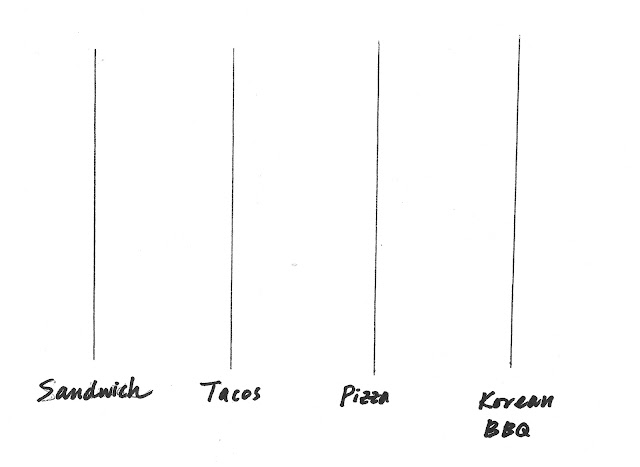 (Yes, that's the Korean's handwriting.)
Now, randomly add the "rungs" to the ladders, like so:

With the rungs, pick a ladder to climb. Climb down by making a turn at every rung -- like so:
 Looks like you are having Korean BBQ for lunch. Of course you are -- why else would you read this blog? :)
Got a question or comment for the Korean? Email away at askakorean@gmail.com.
In both Korea and Japan, there is this ladder which is like a 'game' where it can help one randomly choose something as it goes up the ladder. What is this called and how does it work?
April S.
Dear April,
The game is called "Climbing the Ladder" [사다리 타기], and it is used exactly as you described -- to help random choice. This is how it works. Suppose you want to choose what to have for lunch -- sandwich, tacos, pizza or Korean BBQ. With four choices, you draw four vertical lines, like so:
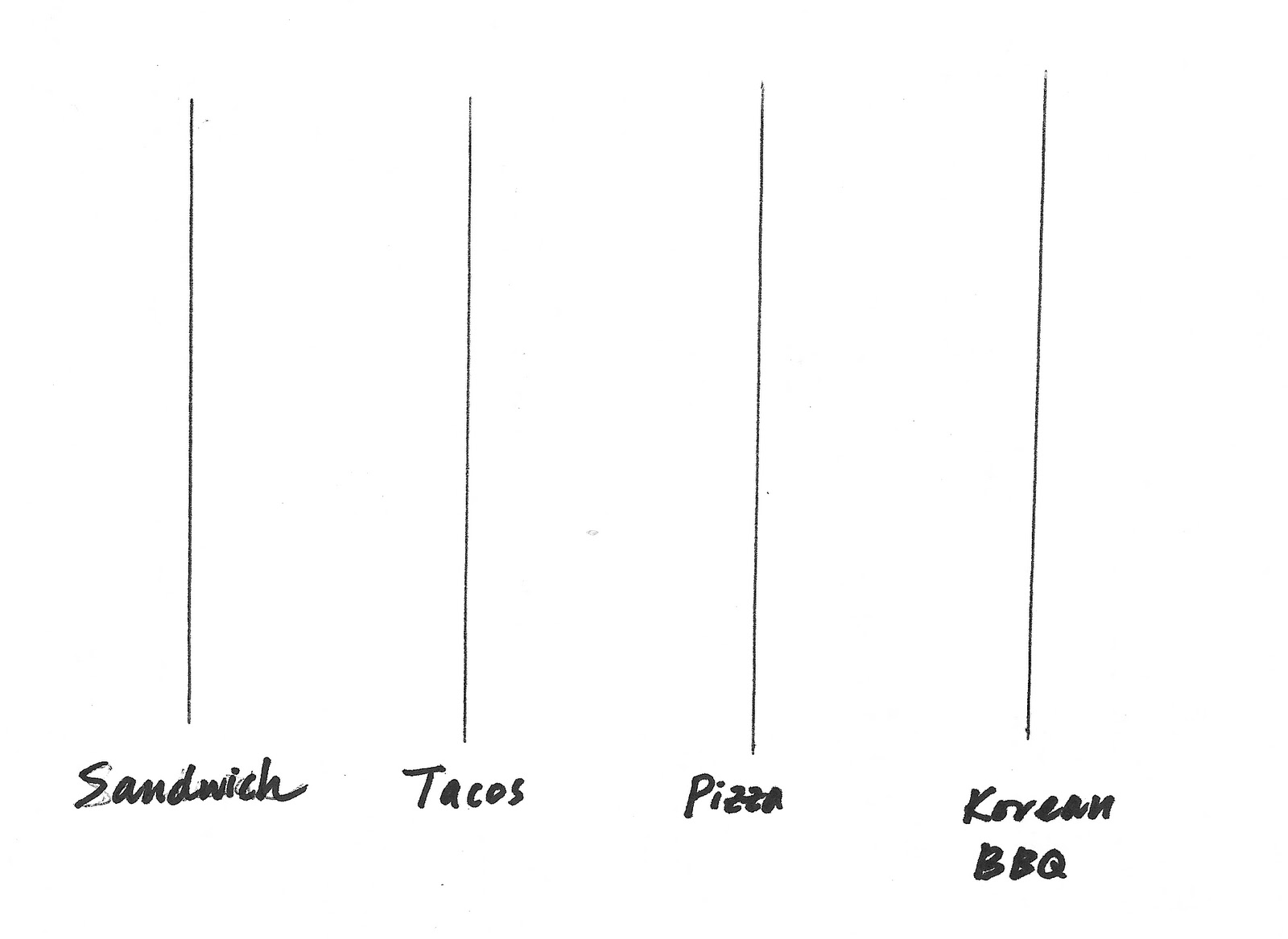
Now, randomly add the "rungs" to the ladders, like so:

With the rungs, pick a ladder to climb. Climb down by making a turn at every rung -- like so:

Got a question or comment for the Korean? Email away at askakorean@gmail.com.
Wednesday, December 08, 2010
The Korean will have a post on drug laws in Korea, but just know one thing -- marijuana is punished just as harshly as any other illegal drug in Korea. Also, many non-Koreans in Korea suffer through the unfair stereotype that they are all drug-addled criminals, because some visitors to Korea just cannot stop toking.
So please, do not smoke marijuana when you are in Korea. And if you must smoke, smoke in the privacy of your house or a hotel room, not in the smoking room of the Incheon Airport. And if you must smoke a joint in the smoking room of the Incheon Airport, please do not record it and put it up on Youtube, you fucking idiots.
인천공항 흡연실서 단체로 대마초 흡입? [Dong-A Ilbo]
So please, do not smoke marijuana when you are in Korea. And if you must smoke, smoke in the privacy of your house or a hotel room, not in the smoking room of the Incheon Airport. And if you must smoke a joint in the smoking room of the Incheon Airport, please do not record it and put it up on Youtube, you fucking idiots.
인천공항 흡연실서 단체로 대마초 흡입? [Dong-A Ilbo]
Monday, December 06, 2010
50 Most Influential K-Pop Artists: 41. Yoo Seung-Joon
[Read more reviews from the Korean from the Library Mixer. To join, click here.]
[Series Index]
41. Yoo Seung-Joon [유승준]
Years of Activity: 1997-2002 (Active in China from 2002-present)
Discography:
West Side (1997)
For Sale 1998 V2 (1998)
Now or Never (1999)
Over and Over (1999)
Summit Revival (2000)
Infinity (2001)
Permission: Promise of Jun [승낙 - Promise of Jun] (2006)
Rebirth of YSJ (2007)
Representative Song: Nanana from For Sale 1998 V2
Translation Note: Some lines ended up being very inelegant, although the underlying song is not particularly elegant at any rate. As always, suggestions are welcome.
In 15 Words or Less: Pioneering rapper whose career ended up in the monstrous bowels of Korean society.
Maybe he should have been ranked higher because... Serving as Exhibit A of the sickness of Korean society might be more influential than one might think.
Maybe he should have been ranked lower because... The flash he demonstrated early in his career was already getting old by 2002.
Why is this artist important?
Yoo Seung-Joon -- also known as his American name, Steve Yoo -- is in many ways a pioneering figure in Korean pop culture. Like Solid, Yoo was a Korean American artist who brought in elements of American pop culture -- in his case, rap. And not just any rap; the aggressive, authority-defying, "thug life" kind of rap prevalent in American rap at the time. His first hit song was about liking older women (horror of horrors!) The music video for Nanana took it a step further, displaying Yoo in all possible variations of thug-life style power play in Korea -- best fighter in class, romantic liaison with a female teacher, etc. Of course, by the standards of today (both in U.S. and in Korea,) Yoo's attempt at defiance of authority is at best cute, at worst laughable. But heck, the first airplane by the Wright Brothers was also pretty laughable in isolation. What matters is that the attempt happened, paving the way for others.
But those who are well-versed in K-pop history would know that his music is not the thing for which Yoo is remembered in Korea. Yoo's high-flying career met a fiery death in 2002 in a manner he probably never expected.
Until that point, Yoo was arguably the biggest star in K-pop. Yoo's brand of brash rap was as big a hit as it was back in U.S. His good looks and unthreatening exoticism from being a Korean American acted as a magnet for screaming fan girls, arguably the engine of K-pop. In a way, Yoo was LeBron James of his day -- his dominance was that strong. But Yoo's fall, whose cause was also essentially a public relations mistake, was far deeper and irredeemable than James'.
In 2002, as Korean American pop artists increasingly appeared in K-pop scene, the question of mandatory draft reared its head. If a Korean American (loosely defined) is a Korean citizen with American permanent residency, he is eligible for draft if he earns money from Korea. There were some cases in which small-fry Korean American pop artists did certain things to avoid being drafted, which raised suspicion on Korean American artists generally.
Yoo was already raising suspicion before 2002. Although on stage he would engage in rigorous choreography, he managed to get a Level 4 in his draft physical with a stated cause of herniated disk, which would assign him to administrative duties for his military service. But at least he was going, people thought -- and Yoo publicly stated that he would serve his "holy duty of national defense." He was scheduled to report for duty in April 2002.
Until he didn't. In January 2002, the news that Yoo acquired U.S. citizenship and would not serve his military duty as a result broke -- and Korean society roiled into rage in a scale that no one (and certainly not Yoo himself) could have anticipated. What Yoo, who grew up in Southern California since age 13, never quite grasped was how seriously Korean men took their years of service. Truth is, few men in Korea want to serve the duty for 2.5 years, pissing away their precious youth. Few ever enjoy the military, alternately filled with bullshit and boredom. But they nonetheless report for duty, because they have to. They grit their teeth and tolerate the bullshit, because they have to. And when they see someone who is not pulling his weight? Then all hell breaks loose.
Yoo bore the full brunt of that hell. This was early days of high-speed Internet in Korea, where news spread fast and reactions were instantaneous. The keyboard warriors went to work, screaming and howling about Yoo's betrayal. The powers that be at the time did not yet have the ability to discern what was legitimate public opinion and what was malicious trolling -- which might not have mattered in Yoo's case after all, since they likely would have been pissed off all the same. Yoo lied about serving in the military. All other concerns were secondary.
Korea's Ministry of Justice considered him to be a draft-dodger, a criminal. As a criminal, Ministry of Justice declared, Yoo would not be able to enter Korea ever again. Yoo tried to explain somehow, blaming that it was his management company that made the decision. But at the end of the day, there was no way to escape the fact that he acquired U.S. citizenship to evade his military duty. He was allowed into Korea only once since then -- in 2003, to attend his father-in-law's funeral. Since then, Yoo has been active in China.
Yoo's musical contribution in K-pop was significant, but the social impact growing out of his disastrous mistake ended up overshadowing everything. Because of Yoo, Koreans began to have a national conversation on topics that were not discussed before. What was the value of military service? How is the precise relation between Koreans and Korean Americans? Considering that one of the major themes of the 2002 presidential election of Korea was that the losing candidate's son suspiciously did not serve his military duty, a case can be made that Yoo Seung-Joon's influence may have been greater than anyone else on this list -- a meaningless consolation to a truly talented musician whose life was broken by his own country.
Interesting Trivia: Yoo's style, like the style of American rappers that he emulated, elicited a lot of hostility from other rappers. In 1998, a prominent rapper Kim Jin-Pyo rapped, obviously aiming at Yoo:
Got a question or a comment for the Korean? Email away at askakorean@gmail.com.
[Series Index]
41. Yoo Seung-Joon [유승준]
Years of Activity: 1997-2002 (Active in China from 2002-present)
Discography:
West Side (1997)
For Sale 1998 V2 (1998)
Now or Never (1999)
Over and Over (1999)
Summit Revival (2000)
Infinity (2001)
Permission: Promise of Jun [승낙 - Promise of Jun] (2006)
Rebirth of YSJ (2007)
Representative Song: Nanana from For Sale 1998 V2
나나나
Nanana
기억하고 있니 어릴 적 예쁜 꿈들을
Do you remember those pretty dreams when you were young
모두 다 이룰 수 있을 것 같던 시간들
The times when everything seemed possible
소망을 꿈꾸며 주문을 외었지
We dreamed hope and recited a spell
시간이 지나고 세상에 지쳐 갈때쯤
As the time passed and by the time I got tired from the world
꿈은 그저 꿈일 뿐인걸 알게 됐지만
I learned that dream is just a dream
어릴적 주문을 아직 노래 하네
But I still sing the spell from my childhood
언제나 힘들고 지칠 때 날 일으켜 주던 꿈이 가득한 이 노랠 했어
I sang this song full of dreams that picked me up whenever I was in pain and fatigue
나나나나 나나나나 나나나나 나나나나
Nananana nananana nananana nananana
어두워진 가리워진 나의 길을 밝혀주는 이 노래를 함께 해봐
Sing this song with me that illuminates my darkened hidden way
[Rap]
난 그냥 되는 되는데로 살았었지
I just lived as the life took me
간섭받기 싫어 그냥 피했던 거지
Didn't want to be told what to do, just avoided everything
내일의 두려움도 필요없어
Didn't need to fear tomorrow either
그런 막막함이 내 시간만 좀먹었었어
Being at a loss like that ate away my time
그러다 내 어릴적 꿈을 보았었지
Then I saw the dream from my childhood
거친 바람속 내 어릴 적 노랠 들었지
In the roaring wind, heard my childhood song
그래 이건 아니었어 용서할 수 없어
That's right, this isn't it, this is unforgivable
다시 나를 살린 이 노래를 불렀었지
Sang this song that made me live again
어느샌가 내게 찾아온 사랑을 위해
For the love that came to me without even me noticing
그렇게도 나를 애태운 그대를 위해
For you who worried so much for me like that
영원을 꿈꾸며 주문을 외웠지
I recited the spell dreaming of eternity
피해갈 수 없는 현실에 지쳐갈 때쯤
As I got tired from the inevitable reality
무거워져 가는 걸음에 힘겨울 때면
When I feel pain from the steps that become heavier
어릴 적 주문을 노래하곤 했지
I would sing the spell from when I was young
언제나 힘들고 지칠 때 날 일으켜 주던 꿈이 가득한 이 노랠 했어
I sang this song full of dreams that picked me up whenever I was in pain and fatigue
나나나나 나나나나 나나나나 나나나나
Nananana nananana nananana nananana
어두워진 가리워진 나의 길을 밝혀주는 이 노래를 함께 해봐
Sing this song with me that illuminates my darkened hidden way
[Rap]
자꾸만 어긋나 버리고 퇴색해 버리는 내 꿈을 지키고 싶었어 이루고 싶었어
I wanted to protect my dream, achieve my dream that was going the wrong way, fading away
누구도 가식의 가면을 버리지 않으리 끝끝내 발버둥 칠때에 또 감추려 할때에
Nobody will take off their mask of hypocrisy as they struggle and hide to the bitter end
하늘에 새긴 내 어린 꿈들이 내 귓가에 들려준 이 노래 내 순수의 노래
This song that my childhood dreams in the sky sang into my ears, the song of my innocence
키 작은 아이의 함성과 내 사랑이 내게 들려준 이 노래 지켜갈 이 노래
This song that a shout from short kid and my love sang into me, the song that I will protect
언제나 힘들고 지칠 때 날 일으켜 주던 꿈이 가득한 이 노랠 했어
I sang this song full of dreams that picked me up whenever I was in pain and fatigue
나나나나 나나나나 나나나나 나나나나
Nananana nananana nananana nananana
초라하게 변해버린 나의 꿈을 밝혀주는 이 노래를 함께 해봐
Sing this song with me that illuminates my shriveled dream
Translation Note: Some lines ended up being very inelegant, although the underlying song is not particularly elegant at any rate. As always, suggestions are welcome.
In 15 Words or Less: Pioneering rapper whose career ended up in the monstrous bowels of Korean society.
Maybe he should have been ranked higher because... Serving as Exhibit A of the sickness of Korean society might be more influential than one might think.
Maybe he should have been ranked lower because... The flash he demonstrated early in his career was already getting old by 2002.
Why is this artist important?
Yoo Seung-Joon -- also known as his American name, Steve Yoo -- is in many ways a pioneering figure in Korean pop culture. Like Solid, Yoo was a Korean American artist who brought in elements of American pop culture -- in his case, rap. And not just any rap; the aggressive, authority-defying, "thug life" kind of rap prevalent in American rap at the time. His first hit song was about liking older women (horror of horrors!) The music video for Nanana took it a step further, displaying Yoo in all possible variations of thug-life style power play in Korea -- best fighter in class, romantic liaison with a female teacher, etc. Of course, by the standards of today (both in U.S. and in Korea,) Yoo's attempt at defiance of authority is at best cute, at worst laughable. But heck, the first airplane by the Wright Brothers was also pretty laughable in isolation. What matters is that the attempt happened, paving the way for others.
But those who are well-versed in K-pop history would know that his music is not the thing for which Yoo is remembered in Korea. Yoo's high-flying career met a fiery death in 2002 in a manner he probably never expected.
Until that point, Yoo was arguably the biggest star in K-pop. Yoo's brand of brash rap was as big a hit as it was back in U.S. His good looks and unthreatening exoticism from being a Korean American acted as a magnet for screaming fan girls, arguably the engine of K-pop. In a way, Yoo was LeBron James of his day -- his dominance was that strong. But Yoo's fall, whose cause was also essentially a public relations mistake, was far deeper and irredeemable than James'.
In 2002, as Korean American pop artists increasingly appeared in K-pop scene, the question of mandatory draft reared its head. If a Korean American (loosely defined) is a Korean citizen with American permanent residency, he is eligible for draft if he earns money from Korea. There were some cases in which small-fry Korean American pop artists did certain things to avoid being drafted, which raised suspicion on Korean American artists generally.
Yoo was already raising suspicion before 2002. Although on stage he would engage in rigorous choreography, he managed to get a Level 4 in his draft physical with a stated cause of herniated disk, which would assign him to administrative duties for his military service. But at least he was going, people thought -- and Yoo publicly stated that he would serve his "holy duty of national defense." He was scheduled to report for duty in April 2002.
Until he didn't. In January 2002, the news that Yoo acquired U.S. citizenship and would not serve his military duty as a result broke -- and Korean society roiled into rage in a scale that no one (and certainly not Yoo himself) could have anticipated. What Yoo, who grew up in Southern California since age 13, never quite grasped was how seriously Korean men took their years of service. Truth is, few men in Korea want to serve the duty for 2.5 years, pissing away their precious youth. Few ever enjoy the military, alternately filled with bullshit and boredom. But they nonetheless report for duty, because they have to. They grit their teeth and tolerate the bullshit, because they have to. And when they see someone who is not pulling his weight? Then all hell breaks loose.
Yoo bore the full brunt of that hell. This was early days of high-speed Internet in Korea, where news spread fast and reactions were instantaneous. The keyboard warriors went to work, screaming and howling about Yoo's betrayal. The powers that be at the time did not yet have the ability to discern what was legitimate public opinion and what was malicious trolling -- which might not have mattered in Yoo's case after all, since they likely would have been pissed off all the same. Yoo lied about serving in the military. All other concerns were secondary.
Korea's Ministry of Justice considered him to be a draft-dodger, a criminal. As a criminal, Ministry of Justice declared, Yoo would not be able to enter Korea ever again. Yoo tried to explain somehow, blaming that it was his management company that made the decision. But at the end of the day, there was no way to escape the fact that he acquired U.S. citizenship to evade his military duty. He was allowed into Korea only once since then -- in 2003, to attend his father-in-law's funeral. Since then, Yoo has been active in China.
Yoo's musical contribution in K-pop was significant, but the social impact growing out of his disastrous mistake ended up overshadowing everything. Because of Yoo, Koreans began to have a national conversation on topics that were not discussed before. What was the value of military service? How is the precise relation between Koreans and Korean Americans? Considering that one of the major themes of the 2002 presidential election of Korea was that the losing candidate's son suspiciously did not serve his military duty, a case can be made that Yoo Seung-Joon's influence may have been greater than anyone else on this list -- a meaningless consolation to a truly talented musician whose life was broken by his own country.
Interesting Trivia: Yoo's style, like the style of American rappers that he emulated, elicited a lot of hostility from other rappers. In 1998, a prominent rapper Kim Jin-Pyo rapped, obviously aiming at Yoo:
혹시 그거 아냐? 여기는 미국 아냐These lines may as well be the most prescient lines ever written in K-pop history.
You know something? This isn't America.
얼어죽을 East Side, West Side 외치지만 말고
Stop saying freakin' "East Side, West Side"
제대로 좀 해봐 몇 년 후에 깡통 매봐
And do something real. Or wear a can a few years later. [="go bankrupt and become a beggar."]
그럼 두고두고 땅을 치고 후회할 테니 그럴 테니 하하하하
Then you will regret it for the rest of your life, that's right, hahahaha.
Got a question or a comment for the Korean? Email away at askakorean@gmail.com.
Saturday, December 04, 2010
Ask a Korean! News: Ground-Level Reactions to Kim Jong-Un
(While the Korean was working on this post, North Korea shelled Yeonpyeong-do. But it is still a worthwhile read.)
As usual, Mr. Joo Seong-Ha never disappoints, as he gathered information about how ordinary North Koreans are feeling about the newly anointed successor. Below is the translation.
On September 28 when the Meeting of the Representatives of North Korean Labor Party, the face of Kim Jong-Un, shown for the first time to the world, was wooden. But by October 10, Kim Jong-Un appeared more relaxed at the platform of the Supreme Leader for the 65th anniversary of the establishment of North Korean Labor Party. He had a dignified air in front of the cameras of foreign media, and would whisper happily with Kim Yeong-Choon, Chairman of the Committee People's Force who was standing beside him.
But this time, Kim Jong-Il was the one with the wooden countenance. The next day, South Korean media all carried the picture in which Kim Jong-Il turned his face to look at Kim Jong-Un on the stage. The face of Kim Jong-Il, who put forth his son on the stage upon which the entire world watched, was filled with worry -- about if he could do well.

Kim Jong-Il is not the only person who is questioning if Kim Jong-Un would do well. The whole world, including South Korea, is gazing upon Kim Jong-Un. North Korean people are not an exception. They are also gazing upon Kim Jong-Un, who all of a sudden appeared as a new leader, with mixed emotions.
After Kim Jong-Un's coming out event, I spoke on the phone several times with my informants in North Korea in order to survey North Korea's popular opinion. Of course, the people along the North Korea-China border who can speak on the phone with South Korea should be considered the "awake" ones of North Korea, perceiving the world events to a certain degree. These people have not a shred of expectation in Kim Jong-Un's succession. The reaction of these people, who have strong aversion to Kim Jong-Il, was obvious. But wouldn't there be some people, who do not speak on the phone with the outside, who support Kim Jong-Un?
(More after the jump)
Got a question or a comment for the Korean? Email away at askakorean@gmail.com.
As usual, Mr. Joo Seong-Ha never disappoints, as he gathered information about how ordinary North Koreans are feeling about the newly anointed successor. Below is the translation.
* * *
But this time, Kim Jong-Il was the one with the wooden countenance. The next day, South Korean media all carried the picture in which Kim Jong-Il turned his face to look at Kim Jong-Un on the stage. The face of Kim Jong-Il, who put forth his son on the stage upon which the entire world watched, was filled with worry -- about if he could do well.
Kim Jong-Il is not the only person who is questioning if Kim Jong-Un would do well. The whole world, including South Korea, is gazing upon Kim Jong-Un. North Korean people are not an exception. They are also gazing upon Kim Jong-Un, who all of a sudden appeared as a new leader, with mixed emotions.
After Kim Jong-Un's coming out event, I spoke on the phone several times with my informants in North Korea in order to survey North Korea's popular opinion. Of course, the people along the North Korea-China border who can speak on the phone with South Korea should be considered the "awake" ones of North Korea, perceiving the world events to a certain degree. These people have not a shred of expectation in Kim Jong-Un's succession. The reaction of these people, who have strong aversion to Kim Jong-Il, was obvious. But wouldn't there be some people, who do not speak on the phone with the outside, who support Kim Jong-Un?
(More after the jump)
Got a question or a comment for the Korean? Email away at askakorean@gmail.com.
Friday, December 03, 2010
Confucianism and Korea - Part I: Introduction
[Series Index]
Dear Korean,
What is the relationship between Confucianism and how individuals communicate. Specifically, how does it influence decision making the age cohorts of those in their 50's and above, 30's to 50's and those under 30. and the flow of communication in the present age?
We've Got Seoul
Dear Korean,
I've been studying Korean independently for about 1 1/2 years now and I really get into the culture, language, music, movies etc. There's various things I've read but I'm not sure 100% if they really aspects of Korean culture derived from Confucianism specifically. So I was wondering if many aspects of Korean culture and traditions are derived from Confucianism and if so what types of things?
Rachel M.
Boy, those are some big questions. Many 1000-page books and doctoral dissertations have been written regarding Confucianism's impact on Korea. This question is particularly difficult for a number of reasons, including:
- Difficulty of defining just exactly what "Confucianism" is. For example, Protestants at least have one literary source (the Bible) to consistently refer to, if they wanted to define what "Christianity" is. But even dealing with just one book, many people have severe disagreements about what "Christianity" is. (Is it a religion that preaches loving thy enemies, or eradicating thy heretics?) Some might point to The Analects, the teachings of Confucius himself, as the Bible equivalent -- but that would be a serious mistake. Confucianism is not a religion, and Confucius is not a deity. Therefore, while the teachings directly from Confucius is very important, it is definitely not the be-all, end-all of Confucianism.
- Similarly, Confucianism has evolved over time and split into many branches, including (contrary to the stereotype) a branch that particularly emphasized empirical criticism, natural science and technology, which actually had a lot of traction in Korea from 17th through 19th century. The difference among these branches are as stark as the gap between the witch-burning Puritans and Mardi Gras-celebrating Catholics.
- Even if a workable definition of "Confucianism" can be somehow found, it is near impossible to isolate Confucianism's impact in Korea, because it requires imagining what Korean would be like if it were not for Confucianism. What is the influence of Confucianism, and what is the influence of inherent tendencies that are universal to all mankind?
Take the deep-rooted sexism in Korea, for example. Many observers (Korean and non-Korean) blame Confucianism influence for that. But it's not as if sexism does not exist in parts of the world that have never heard of Confucianism. In fact, until the advent to postmodern liberal democracy, blatant forms of sexism existed in nearly every society on the globe. So it must be that the cause for sexism in Korea goes deeper than Confucianism. It is more likely that all humans are by nature inclined for sexism, and they end up building various kinds of philosophical superstructures that justify the sexism somehow. (Mind you, this is NOT to say that sexism is somehow justified. There are plenty of cases in which human's natural inclinations are nonetheless wrong and immoral.)
- Related to the point above, there is a tendency to blame Confucianism for just about everything that people don't like about Korea. This tendency appears quite frequently among complaints by expats, but Koreans themselves are just as happy to indulge in this also. A bestseller nonfiction from 1999 with a provocative title, "Confucius Must Die for the Country to Live," blamed Confucianism for, among other things, Korea's drinking problem, corruption, sexism, military dictatorship, lack of creativity, and so on and so forth. This type of rhetoric is obviously imprecise, and often a result of not really understanding what Confucianism even means. (And again, the meaning of Confucianism is rather elusive.)
Since this topic will have to involve a deep examination, the Korean will discuss in a series going forward. Feel free to add more questions about Confucianism and Korea, and the Korean will address them all later in the series.
Got a question or a comment for the Korean? Email away at askakorean@gmail.com.
Dear Korean,
What is the relationship between Confucianism and how individuals communicate. Specifically, how does it influence decision making the age cohorts of those in their 50's and above, 30's to 50's and those under 30. and the flow of communication in the present age?
We've Got Seoul
Dear Korean,
I've been studying Korean independently for about 1 1/2 years now and I really get into the culture, language, music, movies etc. There's various things I've read but I'm not sure 100% if they really aspects of Korean culture derived from Confucianism specifically. So I was wondering if many aspects of Korean culture and traditions are derived from Confucianism and if so what types of things?
Rachel M.
Boy, those are some big questions. Many 1000-page books and doctoral dissertations have been written regarding Confucianism's impact on Korea. This question is particularly difficult for a number of reasons, including:
- Difficulty of defining just exactly what "Confucianism" is. For example, Protestants at least have one literary source (the Bible) to consistently refer to, if they wanted to define what "Christianity" is. But even dealing with just one book, many people have severe disagreements about what "Christianity" is. (Is it a religion that preaches loving thy enemies, or eradicating thy heretics?) Some might point to The Analects, the teachings of Confucius himself, as the Bible equivalent -- but that would be a serious mistake. Confucianism is not a religion, and Confucius is not a deity. Therefore, while the teachings directly from Confucius is very important, it is definitely not the be-all, end-all of Confucianism.
- Similarly, Confucianism has evolved over time and split into many branches, including (contrary to the stereotype) a branch that particularly emphasized empirical criticism, natural science and technology, which actually had a lot of traction in Korea from 17th through 19th century. The difference among these branches are as stark as the gap between the witch-burning Puritans and Mardi Gras-celebrating Catholics.
- Even if a workable definition of "Confucianism" can be somehow found, it is near impossible to isolate Confucianism's impact in Korea, because it requires imagining what Korean would be like if it were not for Confucianism. What is the influence of Confucianism, and what is the influence of inherent tendencies that are universal to all mankind?
Take the deep-rooted sexism in Korea, for example. Many observers (Korean and non-Korean) blame Confucianism influence for that. But it's not as if sexism does not exist in parts of the world that have never heard of Confucianism. In fact, until the advent to postmodern liberal democracy, blatant forms of sexism existed in nearly every society on the globe. So it must be that the cause for sexism in Korea goes deeper than Confucianism. It is more likely that all humans are by nature inclined for sexism, and they end up building various kinds of philosophical superstructures that justify the sexism somehow. (Mind you, this is NOT to say that sexism is somehow justified. There are plenty of cases in which human's natural inclinations are nonetheless wrong and immoral.)
- Related to the point above, there is a tendency to blame Confucianism for just about everything that people don't like about Korea. This tendency appears quite frequently among complaints by expats, but Koreans themselves are just as happy to indulge in this also. A bestseller nonfiction from 1999 with a provocative title, "Confucius Must Die for the Country to Live," blamed Confucianism for, among other things, Korea's drinking problem, corruption, sexism, military dictatorship, lack of creativity, and so on and so forth. This type of rhetoric is obviously imprecise, and often a result of not really understanding what Confucianism even means. (And again, the meaning of Confucianism is rather elusive.)
Since this topic will have to involve a deep examination, the Korean will discuss in a series going forward. Feel free to add more questions about Confucianism and Korea, and the Korean will address them all later in the series.
Got a question or a comment for the Korean? Email away at askakorean@gmail.com.
Wednesday, December 01, 2010
Ask a Korean! News: South Koreans are Pissed Off at North Korea
The Korean previously mentioned that in the face of North Korean attacks, South Koreans generally tend to grit their teeth without necessarily expressing their frustration. But that is the general case -- and the exceptions to that general case are rather spectacular. For example, we have South Korean veteran's groups burning effigies of Kim Jong-Il and Kim Jong-Un in protest of the attacks:

Got a question or a comment for the Korean? Email away at askakorean@gmail.com.
(Source)
But the reactions of Mr. Kim of Dongducheon-si was probably the best:
Around 6 p.m. on the 26th, at a restaurant in Dongducheon-si, Gyeonggi-do, 50-year-old Mr. Kim who owned the restaurant was drinking soju while watching TV. The television was showing news of North Korea's shelling of Yeonpyeong-do.
“北도발 못참아” 차 빼앗아 민통선 가려… [Dong-A Ilbo]Mr. Kim, a former member of the special forces who lived near the Armistice Line, took this provocation personally. Mr. Kim, heartily drunk, decided that he would go to North Korea and kill Kim Jong-Il. He grabbed a knife from the restaurant and barged into a delivery truck standing on the street. Mr. Kim threatened the driver into abandoning the car and drove the stolen vehicle toward north.
5-6 kilometers away in Dongducheon-si, Gwang'am-dong, Mr. Kim caused a fender-bender. He abandoned the vehicle and ran away from the accident. Mr. Kim then got in a taxi and demanded to be taken to the Civilian Control Line [TK: the line of DMZ beyond which civilians cannot cross]. The taxi driver drove for 30 mintues, and let Mr. Kim out at Gyeonggi-do Yeoncheon-gun Gunnam-myeon Okgye-ri.
Mr. Kim wandered about for more than an hour, looking for the Civilian Control Line. Having been unable to stand the cold any longer, he snuck into a farmhouse nearby the sleep. Mr. Kim was discovered by the farmhouse owner the next morning, and turned himself in to the nearby police station. At the police station, Mr. Kim regretted action and said, "I did this because I was drunk and angry at North Korea's provocations," and added, "I myself think it was pretty pathetic."
On the 29th, Yeoncheon police station announced that Mr. Kim was released on his own recognizance on the charges of aggravated robbery.
Got a question or a comment for the Korean? Email away at askakorean@gmail.com.
Finally, a word that discribes what goes on in the Korean's head: "Translanguaging."
Translanguaging -- An approach to bilingualism where speakers switch from one language to another [New York Times]
Translanguaging -- An approach to bilingualism where speakers switch from one language to another [New York Times]
Subscribe to:
Posts (Atom)


 Posts
Posts

