Thursday, January 08, 2015

Leftovers from 2014: The Nut Gate

Macademia advertisement poking fun at the "nut rage."
(source)

- This is probably not true, but TK will say it anyway: this may be the only news story that was driven mostly by the headline-maker's need for a pun. "Nut rage," "nut gate," "nutjob." We have seen every headline conceivable.

- In all seriousness, however, this was a really big deal in Korea, eliciting reactions that were almost disproportionate to the actual event. To be sure, what happened was definitely outrageous. But there have been more outrageous corporate misdeeds before--ones that actually caused loss of lives rather than a 20 minute flight delay. (One example here.) Yet this incident was the top-line headliner domestic news for two to three weeks straight. Why?

There may be some external factors. The prosecution has been blatantly leaking sensational investigative materials, possibly to help President Park Geun-hye's sagging approval rate. That Cho Hyeon-ah is a woman probably makes her a relatively easier figure to hate.

But TK thinks there is more: an interesting lesson about politics that is not obvious on its face. Perhaps nut gate was so resonant among Koreans because it was so easy to understand. Consider, for example, the Sewol incident. The ferry sinking had so many different angles and narratives that I had to devote four separate posts to the incident--which was still not enough to cover all the different aspects. To this day, Korean society remains divided over what lesson to be learned from the Sewol tragedy. 

In contrast, the nut gate? The entire event took less than 30 minutes with just three actors taking very simple actions. Yet the event managed hit a whole host of Korean society's sensitive spots: the chaebol oligarchy, nepotism within the chaebol, the contemptuous rich, humiliated employees, and so on and so forth. To TK, this is the real reason why the nut gate became such an issue in Korea. Never underestimate an event that gives an easy, neat narrative, no matter how trivial it is as a consequential matter.

- Although TK has a long history of complaining about American air carriers, he was never completely comfortable in Korean airlines--and this is why. The better service that Asian and Middle Eastern airline provides comes at a great psychic cost of the airlines' employees. TK is just fine with a service provider, but many airlines train their flight attendants to be servants.

- Of course, the real winners are the sellers of macadamia nuts. Koreans generally don't eat macadamia, although peanuts, walnuts and pine nuts are popular. In fact, most Koreans have never seen macadamia nuts, and have no idea how it tastes. (To this day, Koreans still refer to the incident as 땅콩 회항, i.e. "peanut return.") This scandal gave macadamia nuts publicity that no amount of money could have bought.

Got a question or a comment for the Korean? Email away at askakorean@gmail.com.

Sunday, January 04, 2015

Leftovers from 2014: The Interview Fiasco

(source)

- First things first: it is far from certain that North Korea actually hacked Sony. It appears that the FBI believes that North Korea is responsible for the Sony hack because the modus operendi of hacking resembles the hack of certain South Korean banks, which is believed to be North Korea's doing. But any hacker can simply imitate the M.O. and blame North Korea. Also, it is far from clear that North Korea is even responsible for the attack on the South Korean banks. As Dong-A Ilbo's Joo Seong-ha explained, North Korea hardly has the capability.

But then again, TK is not sure if it is necessarily a bad thing that North Korea gets blamed for this. Sure, it may not be fair, but do we really care about being fair to the North Korean regime? Any day that North Korea gets deprived of a luxury goods for the elite--say, the internet access--is a good day as far as I am concerned.

- Having said all that, it is difficult for TK to be worked up over this. This movie had all the signs of being a crappy one. Does it really matter if it gets shown in the American theaters? Some say it is the principle of things, but what is that principle exactly? That we will watch a crappy movie for spite?

- This is the best thing to read concerning this whole fiasco. Did Americans get this pissed off when millions were dying from starvation in North Korea? Did the U.S. president weigh in? But who cares about the millions of lives--if you messed with 'Muricans' god-given right to watch a crappy movie, SHIT JUST GOT REAL.

- The greatest tragedy about this fiasco is that the plans for a movie based on Guy Delisle's terrific book, Pyongyang: A Journey in North Korea, was cancelled. Delisle, a Frenchman, had the unusual experience of directing a group of North Korean animators who were doing the grunt work for a French animation company. Steve Carell was supposed to play Delisle. 

But then again, maybe this was for the better as well. Delisle's book was great because of his introspective take on what he observed. Instead of offering grand theories about North Korea, Delisle calmly focuses on the small things that he saw. Steve Carell's movie, however, is described as a "thriller"--which means that it probably would not be calm. Which brings us to the ultimate lesson: the book is better. It always is.

Got a question or a comment for the Korean? Email away at askakorean@gmail.com.

Friday, January 02, 2015

Leftovers from 2014: The KC Superfan

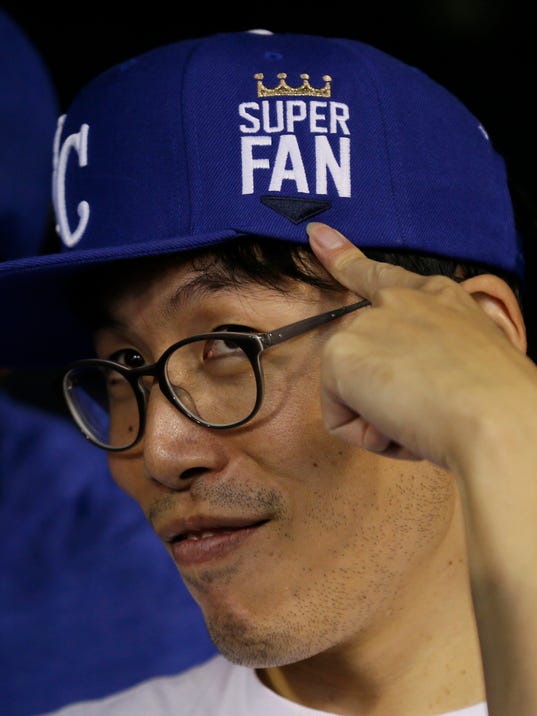
Note:  To make good on TK's promise to blog more, he will give a series of short posts discussing his impressions of Korea-related news with international flavors from 2014 that he could not quite get to last year. First up is Mr. Lee Seong-woo, the KC Superfan.

Lee Seong-woo, a/k/a Kansas City Royals Superfan
(source)

The marvelous story of Lee Seong-woo is a testament to the close relationship between Korea and the United States. Obviously, Lee's story is quite unlikely--which is why it became so viral. But Lee's story was able to overcome the unlikelihood because he was based in Korea. 

There was no superfan unless Philip Gillette, an American missionary, introduced baseball to Korea in 1907. (Recall that, on a global scale, baseball is a relatively regional sport.) There was no superfan unless Korea developed a robust baseball culture, which was clearly influenced by the American baseball culture. There was no superfan unless there was the U.S. troops stationed in Korea, as Lee watched the Major League Baseball on AFKN (now AFN,) the television network for the U.S. soldiers stationed abroad. Finally, there was no superfan unless there was a healthy amount of exchange of people, ideas and stories between the U.S. and Korea.

In Lee's story, parallels with other parts of Korean pop culture are numerous. Korean pop music, for example, moved to another level in the 1950s and 60s because Korean pop musicians had to cater to the U.S. troops who were stationed in Korea following Korean War. Later, K-pop became a global phenomenon as Korean pop musicians consistently knocked on the door of the American pop music market.

Got a question or a comment for the Korean? Email away at askakorean@gmail.com.
Related Posts Plugin for WordPress, Blogger...